Greetings and Happy Friday!
It’s true that earning a good income means one can throw money at most problems that occur in our lives and they will go away. That would imply that, with less problems, we would be happier as well as being less restricted in the pursuit of our goals and purpose in this life. For most of us, this is indeed true.
The article below from Visual Capitalist summarises it nicely from an income-earning view. However, the same principals apply to our capital instead of income- Once we have accumulated enough capital to provide for our needs without having to earn income from employment, it means we’re financially independent; a goal everyone must aspire to sooner or later so as not to be a burden on anyone when we can no longer earn an income to cover our expenses.
Dictionaries define happiness as simply the state of being happy. Being financially independent means you’re part of the solution and that’s a happy place to be.
Charted: Money Can Buy Happiness After All
The Briefing
- Previous research has indicated that money stops buying happiness after $75,000/year (R1.13m per annum)
- However, new research finds a strong correlation between income and happiness, trending upwards even after $80,000/year
In One Chart: Money Can Buy Happiness After All
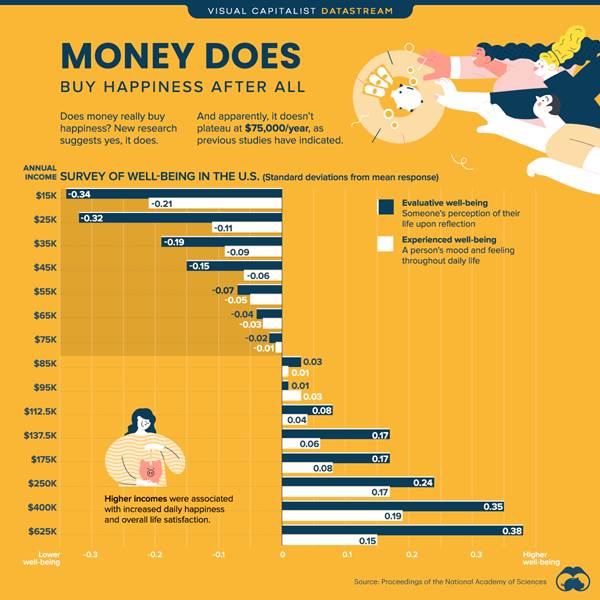
What’s the relationship between money and happiness? Previous studies have indicated that, while money can in fact buy happiness, it plateaus at approximately $75,000/year.
However, new research suggests otherwise.
Using over a million real-time reports from a large U.S. sample group, a recent study found that happiness increases linearly with reported income (logarithmic), and continues to rise beyond the $80,000/year mark.
Below, we’ll provide more details on the research methodology, while touching on a few possible reasons why higher incomes may improve people’s happiness levels.
How is Happiness Measured?
Past research on happiness relative to income has relied on retrospective data, which leaves room for human memory errors. In contrast, this new study uses real-time, logged data from a mood tracking app, allowing for a more accurate representation of respondents’ experienced well-being.
Data was also collected by random prompts over a period of time, with dozens of entries logged for each single respondent. This provides a more well-rounded representation of a person’s overall well-being.
Two forms of well-being were measured in this study:
- Experienced well-being
A person’s mood and feeling throughout daily life. - Evaluative well-being:
Someone’s perception of their life upon reflection.
Both forms of well-being increased with higher incomes, but evaluative well-being showed a more drastic split between the lower and higher income groups.
The Results (Measured in Standard Deviations from Mean)
| Annual Income | Well-Being (Experienced) | Well-Being (Evaluative) |
| $15,000 | -0.21 | -0.34 |
| $25,000 | -0.11 | -0.32 |
| $35,000 | -0.09 | -0.19 |
| $45,000 | -0.06 | -0.15 |
| $55,000 | -0.05 | -0.07 |
| $65,000 | -0.03 | -0.04 |
| $75,000 | -0.01 | -0.02 |
| $85,000 | 0.01 | 0.03 |
| $95,000 | 0.03 | 0.01 |
| $112,500 | 0.04 | 0.08 |
Why Does Money Buy Happiness?
The report warns that any theories behind why happiness increases with income are purely speculative. However, it does list a few possibilities:
- Increased comfort
As someone earns more, they may have the ability to purchase things that reduce suffering. This is particularly true when comparing low to moderate income groups—larger incomes below $80,000/year still showed a strong association with reduced negative feelings. - More control
Control seems to be tied to respondents’ happiness levels. In fact, having a sense of control accounted for 74% of the association between income and well-being. - Money matters
Not all respondents cared about money. But for those who did, it had a significant impact on their perceived well-being. In general, lower income earners were happier if they didn’t value money, while higher income earners were happier if they thought money mattered.
Whatever the cause may be, one thing is clear—Biggie Smalls was wrong. Looks like more money doesn’t necessarily mean more problems.

In the News this Week:
- The rand firmed in February after a subdued start to the year. Firmer global risk appetites and robust commodity prices supported the rand, but sentiment soured towards month-end, as investors grappled with the consequences of the US President ‘going big’ fiscal stimulus for global growth, inflation and interest rates. Rating agencies and global investors were also not overly impressed with SA’s National Budget, casting doubts over the government’s ability to stick to its expenditure targets.
- Global risk appetites are likely to recover in the months ahead. Global growth prospects are brighter due to the rollout of the Covid-19 vaccines, which is gathering pace. Other growth-boosting measures include the massive fiscal stimulus and ultra-accommodative monetary policies in most advanced countries. There is also greater enthusiasm about the outlook for commodity prices, which is widely forecast to strengthen from robust growth in China and the prospect of increased infrastructure investment in developed countries. These forces will drive risk appetites and fuel the hunt for higher yields, supporting foreign capital inflows to emerging market economies (EMEs). The rand will benefit from these trends, but the upside will be limited by domestic factors, particularly high fiscal risks and relatively weak growth prospects.
- The effective rand is now fairly valued based on our calculations of purchasing power parity. We think the upside for the rand is quite limited but expect the currency to remain relatively steady in 2021.
- Lower daily Covid-19 cases and vaccine rollouts help SA move to looser alert level 1 from alert level 3.
- Producer prices rose by 3.5% y-o-y in January from 3% a month earlier.
- Annual growth in M3 and PSCE moderatedto 9.2% and 3.3% from 9.5% and 3.6%, respectively.
- The trade surplus narrowed to R11.8 billion in January.
- The US House of Representatives passed the long-awaited and much-needed $1.9 trillion stimulus.
- The US and German economies grew by slightly more than expected in the fourth quarter, while France contracted more than preliminary estimates.

Please give us a call or email if you need any assistance. Have a great weekend!
Kind regards,
Your TurnPoint Team
Vic Hodoul CFP®
Certified Financial Planner®
Cell +27 (0) 79 353 1076 Email vic@turnpoint.co.za
Office/Admin Manager: Arlene Schoeman: +27 (0)21 555 1010 Email arlene@turnpoint.co.za
TurnPoint Investments
Website: Authorised Financial Services Provider (FSP12820) (turnpoint.co.za)
Milnerton Office: 5 Royal Atlantic, Sunset Beach 7441
Cape town Office: Suite 824, The Onyx, 57 Heerengracht Street, Foreshore 8005
Tel +27 (0)21 555 1010 Fax +27 (0)86 589 2738
Individual and Corporate Investment, Retirement, Estate, Risk and Tax Planning Solutions
TurnPoint Investments (Pty) Ltd. Registration Number 2003/020010/07 | Financial Service Provider (FSP licence number 12820) Directors VD Hodoul DL Hodoul