Greetings and Happy Friday!
In these days of record-high markets, one has to accept that corrections will happen. In fact, we’ve had a couple this year already! They moved so fast that, unless you were watching daily, you probably missed them and that’s a good thing because as a long-term investor you should trust the process and focus on your life instead.
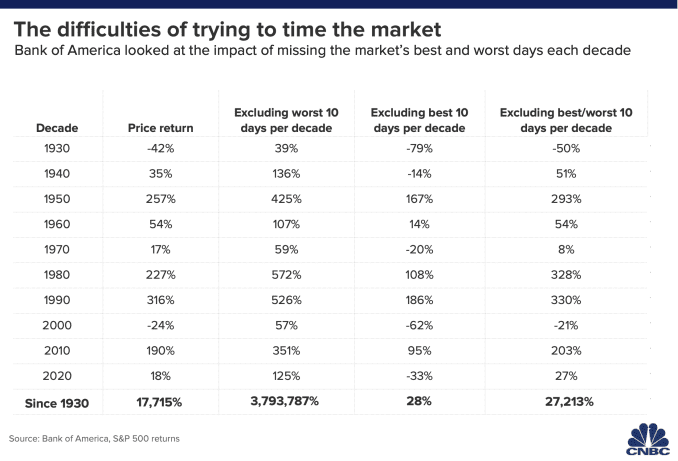
This chart shows why investors should never try to time the stock market
From CNBC
KEY POINTS
- Investors should avoid the impulse to time the market, new data from Bank of America shows.
- Looking at data going back to 1930, the firm found that if an investor sat out the S&P 500′s 10 best days per decade, total returns would be significantly lower than the return for investors who waited it out.
- And the market’s best days typically follow the largest drops, meaning panic selling can lead to missed opportunities on the upside.
Timing the market is difficult at the best of times for even the most experienced traders.
Now, Bank of America has quantified just how large the missed opportunity can be for investors who try to get in and out at just the right moment.
Looking at data going back to 1930, the firm found that if an investor missed the S&P 500′s 10 best days each decade, the total return would stand at 28%. If, on the other hand, the investor held steady through the ups and downs, the return would have been 17,715%.
When stocks plunge a natural impulse can be to hit the sell button, but the firm found the market’s best days often follow the biggest drops, so panic selling can significantly lower returns for longer-term investors by causing them to miss the best days.
“Remaining invested during turbulent times can help recover losses following bear markets – it takes about 1,100 trading days on average to recover losses after a bear market,” noted Savita Subramanian, head of U.S. equity and quantitative strategy at Bank of America.
Sometimes, as happened in 2020, the recovery is much faster.
The data comes amid a boom in retail traders trying to find the next Tesla or Gamestop pop, and as fast, data-driven strategies become more prevalent across Wall Street. But Bank of America noted simple investing for the long term can be a “recipe for loss avoidance” given that 10-year returns for the S&P 500 have been negative just 6% of the time since 1929.
Of course, the data also shows the astronomical returns for any investor who correctly called the ten worst days of each decade — to the tune of 3,793,787%. Additionally, excluding the 10 worst and best days would have registered a gain of 27,213%.
But given the difficulty of precisely calling the peaks and troughs, the better bet is to simply stay in invested.
Bank of America noted that factors including positioning and momentum typically outperform over the short-term, but fundamental analysis wins over multiple years.
“Whereas valuations explain very little of returns over the next one to two years, they have explained 60-90% of subsequent returns over a 10-year time horizon,” the firm noted. “We have yet to find any factor with such strong predictive power for the market over the short term.”
Looking ahead Subramanian envisions more muted returns, or about 2% per year for the S&P 500 over the next decade. Including dividends, returns stand at 4%. The forecast is based on a historical regression looking at today’s price relative to normalized earnings ratio.
The firm added that over prior periods of similar returns, including between 1964 and 1974 as well as from 1998 to 2008, there was a higher probability of loss, pointing to the merits of staying invested for the long haul.

In the News this Week:
- For the first time since April 2020, when the Reserve Bank’s Monetary Policy Committee (MPC) was cutting aggressively, the committee took a unanimous decision (Table 1). The change in voting patterns usually signals a looming shift in the MPC’s stance. Two MPC members who had voted for a cut since September are now favouring flat rates, suggesting that the committee’s view could start to tilt towards hiking the repo rate.
- The SARB’s Quarterly Projection Model (QPM) still reflects a 25 basis points (bps) hike in the second quarter of 2021, but the other hike has now moved back to the fourth quarter from the third quarter. The model then suggests further hikes totalling 100 bps each in 2022 and 2023.
- Inflation outlook: The SARB’s forecasts have moved slightly higher in the short term, but consumer inflation is still projected to hover around 4.5% up to the end of 2023 (Table 2). CPI is now forecast to peak at 4.9% in the second quarter of 2021, compared with 4.5% at the January meeting, and to ease to 4.2% in the third quarter of 2022 before fluctuating around 4.5%. Core inflation forecasts reflect a slightly more benign trajectory relative to the January projections. The risks to the inflation outlook are balanced, although administered prices still pose an upside risk. Electricity will rise at a higher than previously assumed margin after Eskom was granted higher tariff increases. The SARB revised its assumed tariff hikes to 9.7% from 8.2% for 2021 and 11.4% from 10% for 2021, while the assumption for 2023 remained unchanged at 10%.
- Inflation expectations remain moderate, with the Bureau of Economic Research’s first-quarter survey indicating that all economic agents still expect CPI to remain comfortably below 6% until 2023.
- Growth outlook: The SARB expects a slightly firmer recovery in 2021 (Table 2). Although the first quarter is now expected to show a contraction of 0.2% compared with 1% growth at the January meeting, the rebound will be firmer over the remainder of the year and slightly push annual growth to 3.8% (previously 3.6%). Growth forecasts for the next two years were unchanged. Risks to the growth outlook are still assessed to be balanced. However, developments relating to the global rollout of Covid-19 vaccines and long-standing domestic constraints remain a key hindrance to the recovery. In the Q&A session, the Governor conceded that electricity supply constraints posed a downside risk to the SARB’s growth forecasts.
- Exchange rate view: The rand remains below its long-run fair value per the SARB’s assessment. The latest inflation forecasts are based on a rand starting point of R14.96 /US dollar compared with R15.70 at the previous meeting.
- Outlook: The SARB’s forecasts for growth and inflation remain broadly in line with our expectations. We maintain our view that the fragile economic recovery and subdued inflation rates suggest that the repo rate will remain flat throughout 2021. However, the change in voting patterns suggests that the chance of the first hike in 2021 is higher than at the January meeting.
- Annual headline consumer inflation eased by 2.9% y-o-y in February from 3.2% in January, below our and the market’s forecast. Among the major sub-categories, ‘health’ and ‘miscellaneous goods and services’ grew at a softer pace, making a lesser contribution to the headline figure. By contrast, ‘transport’ made a significant positive contribution. The main contributor was ‘food and non-alcoholic beverages’, which added 0.9 percentage points to the total (the same as last month). ‘Housing and utilities’ and ‘miscellaneous goods and services’ added 0.6 percentage points each. Food price inflation continued to fall as meat prices moderated. Fuel prices increased further. Surprisingly, alcoholic beverages prices rose over the reporting period. The Statistical agency noted that there were no base prices available for alcoholic beverages due to the ban on sales in January. As a result, the indices affected by the ban were imputed using the headline change in inflation.
- Over the month, prices increased by 0.7%, with the transport and miscellaneous goods and services categories contributing 0.3 and 0.4 percentage points respectively.
- Core inflation eased to a record low of 2.6% y-o-y, reflecting weak underlying demand conditions. Goods inflation rose to 3.1% from 2.7% in January, driven mostly by non-durable goods, which accelerated by 3.5% from a sticky 2.8% in the previous two months. Prices of durable goods slowed to 2.9%, while that of semi-durable goods was static at 1.1%. Services inflation declined significantly, down for the seventh successive month to 2.7% from 3.9% in July 2020. Over the month, core inflation rose by 0.6%.
- Consumer inflation slowed to levels last seen during the strict lockdown last year. Inflation is expected to edge higher in the months ahead, with some upward pressure coming from higher fuel prices and electricity tariffs. Still, prices will be contained by subdued domestic demand and a stronger rand. The bulk of the upward drift will reflect the effect of last year’s extremely low base. On balance, inflation is likely to remain well contained. As a result, we believe the Reserve Bank will keep interest rates unchanged at the current levels for the remainder of this year.

Please give us a call or email if you need any assistance. Have a great weekend!
Kind regards,
Your TurnPoint Team
Vic Hodoul CFP®
Certified Financial Planner®
Cell +27 (0) 79 353 1076 Email vic@turnpoint.co.za
Office/Admin Manager: Arlene Schoeman: +27 (0)21 555 1010 Email arlene@turnpoint.co.za
TurnPoint Investments
Website: Authorised Financial Services Provider (FSP12820) (turnpoint.co.za)
Milnerton Office: 5 Royal Atlantic, Sunset Beach 7441
Cape Town Office: Suite 824, The Onyx, 57 Heerengracht Street, Foreshore 8005
Tel +27 (0)21 555 1010 Fax +27 (0)86 589 2738
Individual and Corporate Investment, Retirement, Estate, Risk and Tax Planning Solutions
TurnPoint Investments (Pty) Ltd. Registration Number 2003/020010/07 | Financial Service Provider (FSP licence number 12820) Directors VD Hodoul DL Hodoul